

Three conversion architectures, emerging field evidence, and the milestones that matter to AI infrastructure projects
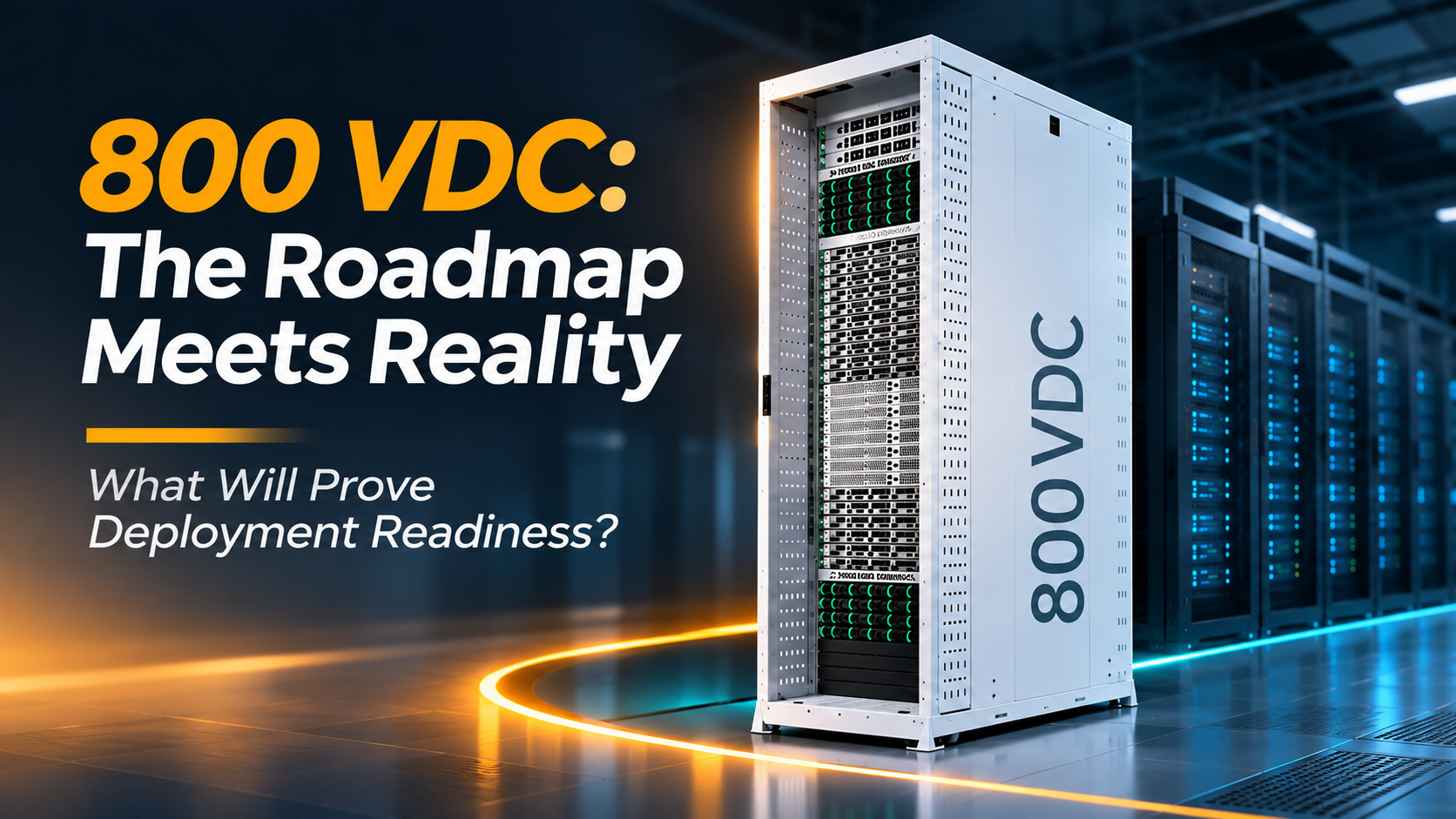
Agreement on voltage is not proof of deployment readiness.
800 VDC is moving beyond architectural proposals toward product development, testing, and early field applications. Yet production plans, functional demonstrations, and operating installations represent different levels of progress.
For data center owners and designers, the real question is what has been demonstrated—and what evidence is needed to move from promising technology to deployable infrastructure.
Integrated rectification and DC distribution are not new data center concepts.
In November 2019, Alibaba’s Panama power project was formally established at the Open Data Center Committee (ODCC). Its original reference design converted 10 kVAC to 240 VDC, combining medium-voltage input, phase-shifting transformers and rectification. The subsequent ODCC white paper also examined 240/336 VDC arrangements.
Panama provides a precedent for integrated power conversion, rather than a direct lineage for every current 800 VDC design. Today’s challenge is the concentration of much more computing power within individual racks and clusters.
Data centers commonly distribute 400/415/480 VAC toward IT equipment, with conversion to low-voltage DC closer to the computing load. As rack power rises, distributing that power at 48/54 VDC places increasing demands on conductors, busbars, connections and available space.
For the same theoretical 1 MW DC load, ignoring conversion losses, current decreases from approximately 18,500 A at 54 VDC to 1,250 A at 800 VDC.
These are aggregate currents at the respective voltage levels. Practical systems may divide the load among multiple parallel power paths; the figures do not imply a single conductor carrying the entire current. Nor do they compare the losses of complete AC and DC facility architectures.
The example illustrates the physical incentive for higher-voltage distribution. It does not eliminate the remaining engineering work.
AI power systems must also accommodate rapid, sometimes synchronized GPU load changes, maintain voltage within the required limits and coordinate short-duration energy support. Raising the distribution voltage changes where conversion, protection, cooling and maintenance must be provided.
At the same ideal 1 MW load, current would fall to 1,000 A at 1,000 VDC and 500 A at 2,000 VDC.
However, increasing voltage also changes semiconductor requirements, insulation coordination, connectors, switching transients, DC interruption and service procedures. Lower current alone does not determine the preferred system voltage.
The current focus on 800 VDC reflects an emerging equipment ecosystem and computing-interface direction, not proof of a mathematically optimal voltage. OCP’s LVDC work extends to 1,500 VDC, but that scope should not be mistaken for the selection of a future 1,500 VDC rack interface.
The main architectural distinction is where AC/DC conversion occurs and how far DC distribution extends.
Rack-level, pod-level and facility-level are useful categories, not mandatory stages through which every data center must progress.
Here, rack-level means rack-adjacent AC/DC conversion in a Power Rack or sidecar. It does not mean the converter is installed inside the compute rack, and one sidecar may serve more than one compute rack.
A typical power path is:
415/480 VAC → Power Rack → 800 VDC → Compute Rack
This approach can preserve much of the upstream AC architecture while introducing an 800 VDC interface close to the load. It offers a potential route for phased adoption in existing facilities.
The constraints remain physical: cabinet footprint, feeder capacity, DC connections and protection, conversion losses, cooling and maintenance access. Preserving the AC architecture does not guarantee that an existing row has sufficient power or space.
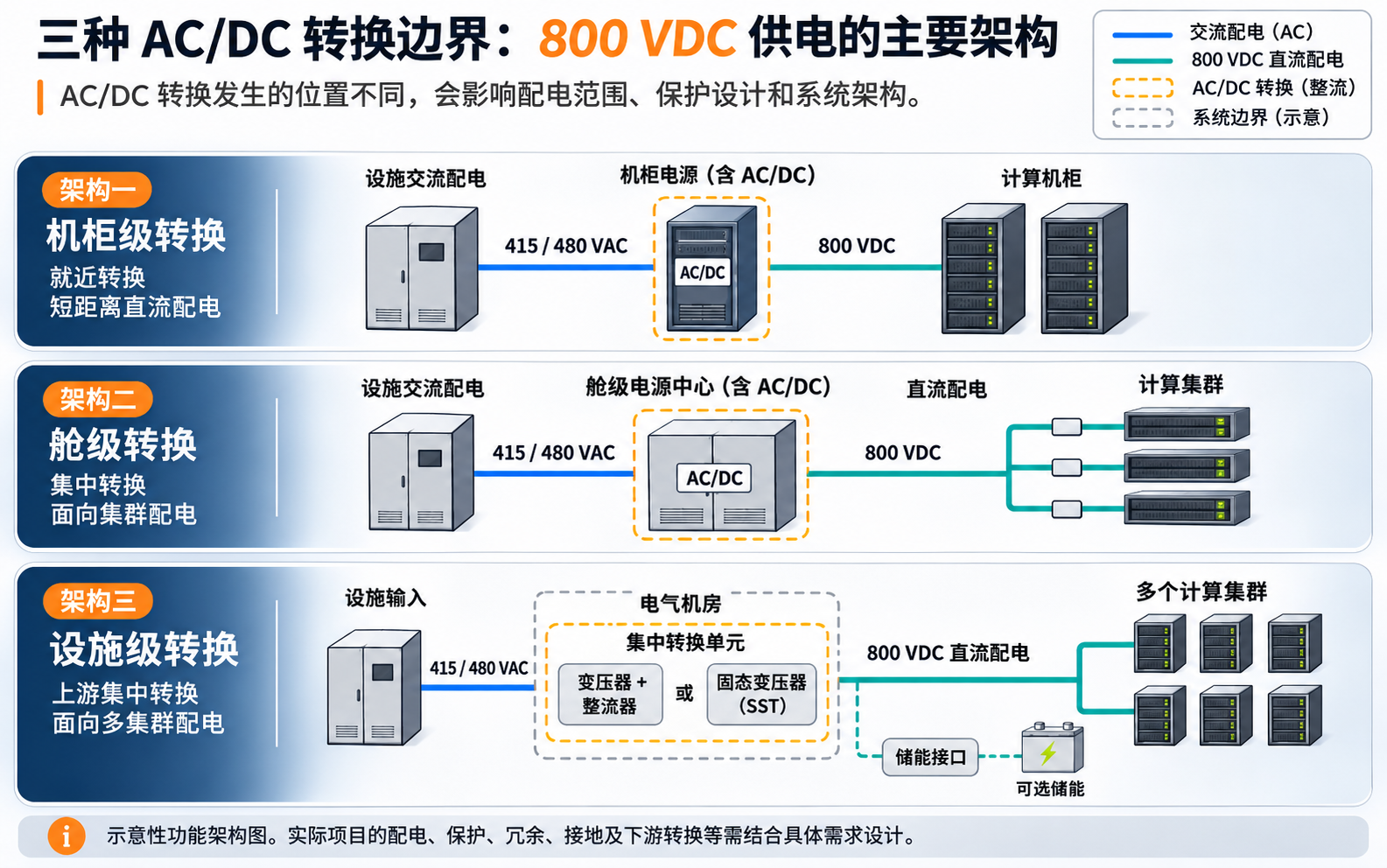
A pod or row power center converts AC centrally and distributes 800 VDC to multiple compute racks through busways.
Sharing conversion equipment can reduce dedicated sidecars in computing rows. In return, the design must address a wider DC distribution zone, including tap-offs, fault selectivity, isolation, redundant paths and maintenance boundaries.
The outcome depends on the complete topology. Consolidating rectifiers may improve space allocation, but it also changes the potential reach of a fault.
Facility-level designs place conversion in larger electrical power blocks serving multiple computing clusters. Possible approaches include transformer-rectifier units and solid-state transformers (SSTs); an SST is not a requirement of the category.
Centralization can support shared infrastructure and energy-storage integration. It also expands the scope of DC protection, grounding, controls and operational planning.
A reported application in China illustrates this route. On November 2, 2026, Envision announced that an integrated SST-based system at its Galaxy AI data center in Ulanqab was supplying live computing workloads, converting 10 kVAC to 800 VDC with integrated battery storage. A subsequent SemiAnalysis site report described an operating 800 VDC pilot in a 5 MW data hall.
Envision described the project as the world's first commercial deployment of its kind. Detailed commissioning results and long-term performance data have not been publicly disclosed. The case nevertheless illustrates that field deployments need not follow a fixed progression from rack-level to pod-level to facility-level conversion.
As of November 2026, progress toward 800 VDC deployment is becoming tangible. NVIDIA outlined a Q3 2026 Power Rack production timeline, Schneider Electric introduced its NetShelter 800 VDC Power Rack, Vertiv reported functional demonstrations, and SolarEdge demonstrated medium-voltage-to-800 VDC conversion under laboratory load.
These milestones show progress beyond architectural proposals, although product availability, technical validation, and commercial deployment remain distinct stages.
A successful first deployment demonstrates that an 800 VDC system can operate under defined site conditions. The next challenge is repeatability: can the same architecture be delivered at another site with established interfaces, validated protection, consistent commissioning procedures, and reliable service support?
This is where deployment readiness becomes a practical engineering and commercial question rather than a product milestone.
AC and DC distribution are likely to coexist for the foreseeable future. Existing data centers may adopt 800 VDC through rack-level conversion, while new high-density AI facilities may be better positioned for facility-level DC distribution. The choice depends on more than voltage—it also involves conversion efficiency, system protection, maintainability, and total cost of ownership.
OCP is working toward common LVDC interfaces and protection requirements, with its current scope extending to 1,500 VDC. However, the next widely adopted voltage level remains uncertain. As rack power demands increase, higher voltages must balance reduced distribution currents against insulation requirements, protection complexity, and equipment costs.
Ultimately, the significance of 800 VDC may lie less in establishing a permanent voltage standard than in shifting data center power design from equipment-level optimization toward a more integrated, facility-wide architecture.
1. Open Data Center Committee (ODCC). Panama Power Supply Technical White Paper. 2020.
2. NVIDIA. 800 VDC Architecture: Industry Alignment & Execution. 2026.
3. Schneider Electric. 5 Principles for 800 VDC in AI Data Centers: Rack-Level Architectures as the Immediate Enabler. 2026.
4. Vertiv. Power MW-Scale Racks: 800 VDC Architectures for High-Density AI Compute. 2026.
5. SolarEdge Technologies. SolarEdge Advances Full DC Powertrain for AI Data Centers, Publishes 800 VDC Protection Framework With NVIDIA. 2026.
6. Envision. Envision Achieves World's First Commercial Deployment of Integrated 800V DC SST-Based Power System in Large-Scale AI Data Center. 2026.
7. SemiAnalysis. We Visited China's Stargate in Inner Mongolia. 2026.
8. Open Compute Project Foundation. Data Center Facility - Power Distribution Sub-Project. 2026.
Tell us your needs for data center infrastructure, and our team will provide you with customized green & energy-saving integrated solutions with global delivery and fast response.
 EN